Crystl: a macOS terminal for running several coding agents in parallel
Your next creation starts with a sentence. — free credits on sign-up Bring my idea to life
Running one coding agent is easy. Running three or four in parallel on the same repository, without branches colliding or approval requests getting lost across tabs, is a different problem. Crystl positions itself as an answer to that: a native macOS app, written in Swift, described as a multitasking terminal for AI agents. It runs Claude Code, Codex, Antigravity CLI and, more broadly, any command-line agent.
One caveat before going further: everything below comes from the product's official page, which is marketing material. No independent testing is available, and the claimed benefits (lightness, smoothness, quality of orchestration) are not verified by a third party. Read this as a feature description, not a verdict.
The mental model: gems, shards, worktrees
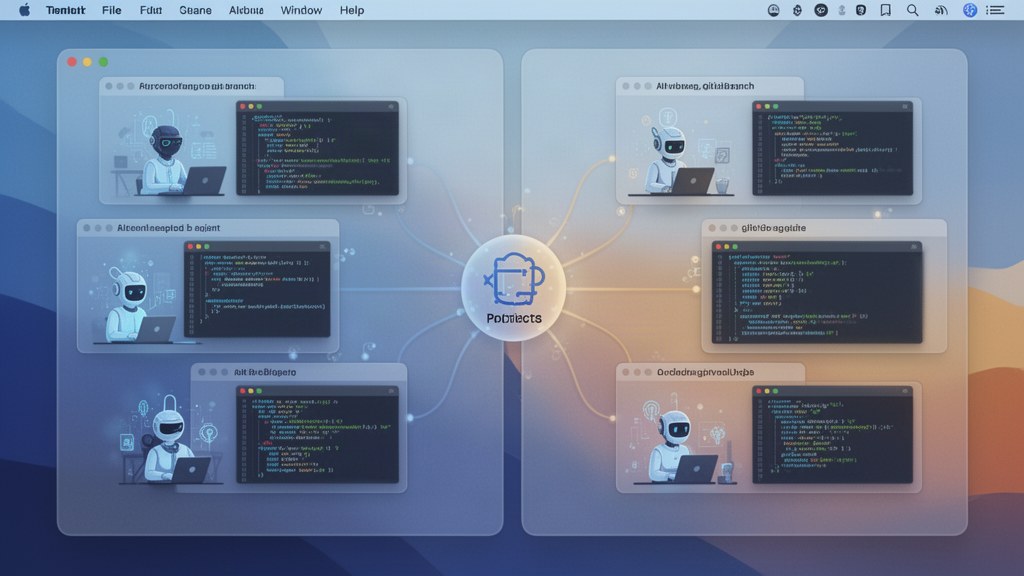
Crystl organises work around two objects. A gem represents a project. A shard represents a session: each shard is a complete terminal attached to a project.
The interesting part is isolation. Several agents can work in parallel on the same repository, each in its own git worktree and on its own branch. In practice, that avoids the classic scenario where two agents edit the same files at once and you spend your time untangling who changed what. For a developer delegating a refactoring task to one agent while another explores a fix, that separation is what makes parallelism actually workable.
The source also states that off-screen shards heavily reduce their rendering to stay light on the machine. That is a product claim, not a published measurement.
What happens when an agent is waiting for an answer
The bottleneck in multi-agent work isn't compute, it's attention. An agent that asks a question or requests approval blocks until it gets a reply. Crystl addresses this with floating cards that surface approval requests, questions and notifications without switching windows.
The depth of integration depends on the agent, though. Claude Code gets the most complete integration. Codex supports the hooks needed for approval cards. Antigravity CLI does not yet support them, so those features aren't available there. Compatibility with other command-line agents (aider, goose, Ollama, Kimi Code) is stated generally, with no detail on what actually works beyond running in a terminal.
Versioned configuration and shared memory
Two design choices are worth flagging, because they address familiar irritations.
First, agent configuration is stored as markdown inside the repository. It is therefore versioned with the code: you can review it, diff it, and evolve it as a team, rather than leaving it locked inside an app's settings.
Second, a shared WORKBENCH.md file serves as a common task list between the user and the agent. The idea is to give both sides a single reference point for what remains to be done.
The source also mentions a project optimiser that scores how ready a project is for agents, ranks gaps and proposes one-click fixes, plus token tracking that counts usage per turn and projects remaining context. Both are described by the vendor; their real usefulness depends on the quality of the recommendations, which can't be assessed without hands-on use.
Orchestration: what's free, what's paid
This is where the line between tiers becomes concrete. According to the source, an orchestrator able to manage sub-agents is reserved for the paid Guild plan. The "crystl quest" mode, which brings specialised agents together in a shared chat to divide work, is also described as part of the product.
The free tier includes isolated shards, floating cards and up to 3 schedules. Guild is listed at $170 per year. No pricing or availability specific to non-US markets is provided.
An iPhone app lets you monitor, approve and launch agents. It is free over Wi-Fi; going through an encrypted relay depends on Guild. The exact workings and limits of that relay are not detailed in the source.
Quick comparison by tier
- Free: shards isolated by worktree, floating approval cards, up to 3 schedules, iPhone app over Wi-Fi.
- Guild ($170/year): orchestrator with sub-agents, encrypted relay for the iPhone app.
- Deepest integration: Claude Code. Partial: Codex (hooks for approval cards). Limited: Antigravity CLI (no hooks as of now).
What it changes for a developer or creator delegating to agents
Crystl's value isn't the terminal itself, but the discipline it imposes: one project, several sessions, each isolated in its own worktree, with an overview of what every agent is doing. For someone who has already adopted Claude Code or Codex and is struggling to manage several workstreams at once, that's a sensible frame.
Three reservations, though. First, the tool is macOS-only: a non-starter on Linux or Windows. Second, the richest integration is tied to one specific agent, which creates dependency. Third, the product's real maturity isn't established: the source gives neither a release date nor a version number, and there's no sign of independent user feedback.
Key takeaways
- Crystl is a native macOS terminal for command-line agents, with Claude Code as its main integration.
- Isolation via git worktree and a dedicated branch is the real argument for multi-agent work on one repository.
- Approval cards save you from watching every tab, but don't yet work with Antigravity CLI.
- Markdown configuration versioned in the repo and a shared WORKBENCH.md: two choices that pull configuration out of the app.
- The sub-agent orchestrator is reserved for the Guild tier at $170/year; the free tier covers isolation, cards and 3 schedules.
- No independent testing is available: treat performance promises as vendor claims.