Gemini 4 Hydrogen: cheaper than Argon and ahead on one ranking, per Google

Your next creation starts with a sentence. — free credits on sign-up Bring my idea to life
Google has released Gemini 4 Hydrogen, a model in its Gemini 4 family positioned as cheaper than Argon, the frontier model of the same generation. According to the announcement relayed by SiliconANGLE, Hydrogen scores 51 against Argon's 50 on the Artificial Analysis Intelligence Index at the default reasoning level. Those figures are attributed to Google and were not independently verified by the source, so they should be read as a claim rather than a reproduced result.
For creators and product teams, the interesting part is less the one-point gap than the price-to-quality mix: Hydrogen is listed at $1.50 per million input tokens and $7.50 per million output tokens across the full one-million-token context. Argon is $2 and $10 on introductory pricing through November 30, then moves to $4 and $20. If quality is broadly comparable on a general index, cost becomes the main argument.
What the ranking actually says
The 51-versus-50 score comes from the Artificial Analysis Intelligence Index, an aggregate of public benchmarks. Google says a fourth reasoning level, called xhigh and new with Hydrogen, lifts the score to 54. Two caveats matter: a one-point gap on a composite index does not guarantee superiority on your tasks, and the source does not detail performance in French, long-form writing or document analysis. No direct head-to-head test between Hydrogen and Argon on real tasks is provided.
The source also notes that Hydrogen did not go through the Fairwind cybersecurity-defender program before release, unlike Argon. That matters mostly to teams evaluating models for sensitive uses; it does not settle how secure the model is, but it points to a different evaluation process.
Speed, coding and Orchestrator
Koray Kavukcuoglu, who became head of Google DeepMind in August, presents Hydrogen as built for fast execution. Google offers two comparisons: against Gemini 3.8 Flash, Hydrogen finishes tasks 2.5 times faster at the default setting, and it scores 57% on Terminal-Bench 4.1 versus 18.2% for the older model. These are Google runs, not independent tests.
For coding, the most concrete element is Orchestrator, added to the Antigravity coding tool: it chooses between Hydrogen and Gemini 4 Carbon over the course of a session. Based on Google's Terminal-Bench 4.0 runs, Orchestrator comes close to Carbon's success rate while using 24% less quota on average. Again a vendor figure, but it describes a realistic pattern: rather than picking one model, let the tool route by task.
Where to use Hydrogen, and when to keep Argon
Hydrogen is available in the Gemini API, Google AI Studio and Google Search, and open to everyone, including users of the free Gemini app. Paying Pro and Ultra subscribers can use it in Antigravity. That broad availability, two days after Carbon opened, fits a fast cadence: three Gemini 4 models shipped in a little over six weeks.
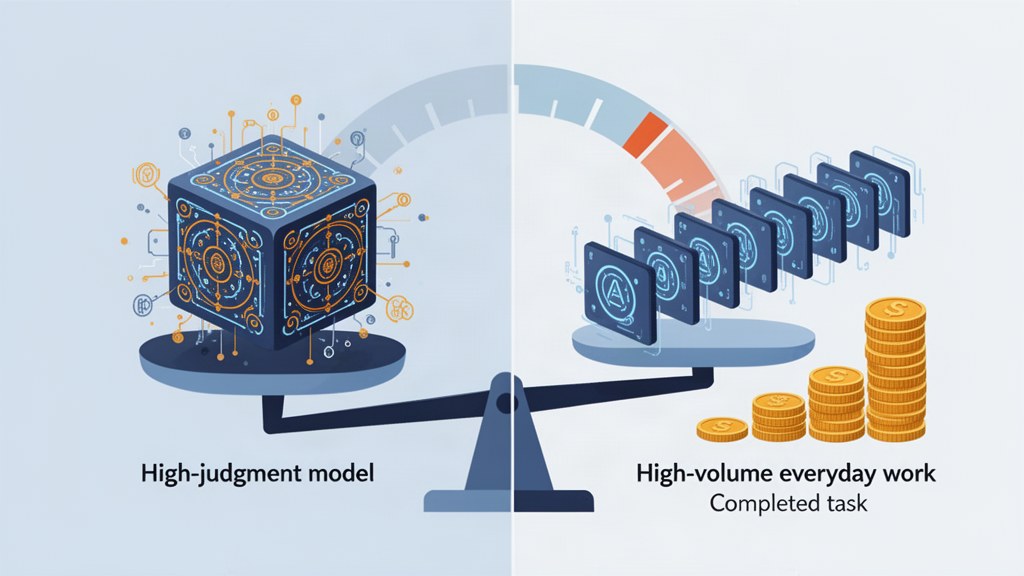
For writing, coding or analysis in French, the sensible move is to start with Hydrogen for high volumes and routine tasks, then switch to Argon if quality on your own content falls short. Hydrogen's lower price makes iteration cheaper; Argon's introductory pricing complicates the comparison until November 30, after which the gap widens sharply.
- Pick Hydrogen for large volumes, drafts, fast tasks and workflows where Orchestrator alternates models.
- Keep Argon when a security evaluation process was required, or if your own trials show a clear edge on long texts or complex analysis.
- Don't decide on the index alone: a one-point gap says nothing about French quality or adherence to an editorial style.
One testimonial, with caution
Among early testers cited, Andrew Carr reports that the model caught two issues that had blocked his team for ten days. That account is reported by Google and not validated by the source; it illustrates a possible use, not proof of superiority.
Key takeaways
Hydrogen is a cheaper, widely available model, claimed to match Argon on a general index and to be faster than Gemini 3.8 Flash according to Google. The performance figures come from announcements and Google-run tests. Before shifting budget, try Hydrogen on your own French prompts, compare it with Argon on a representative sample, and account for Argon's price change on November 30. This article is published by Roboto, a platform for generating texts, images, videos and voiceovers with AI; we ran no tests on these models.
Source
Google releases Gemini 4 Hydrogen, a lower-cost model said to outscore Argon