
The Untold Story of AI: From Its Origins to 2025 Breakthroughs
Your next creation starts with a sentence. — free credits on sign-up Bring my idea to life
The Untold Story of AI: From Its Origins to 2025 Breakthroughs
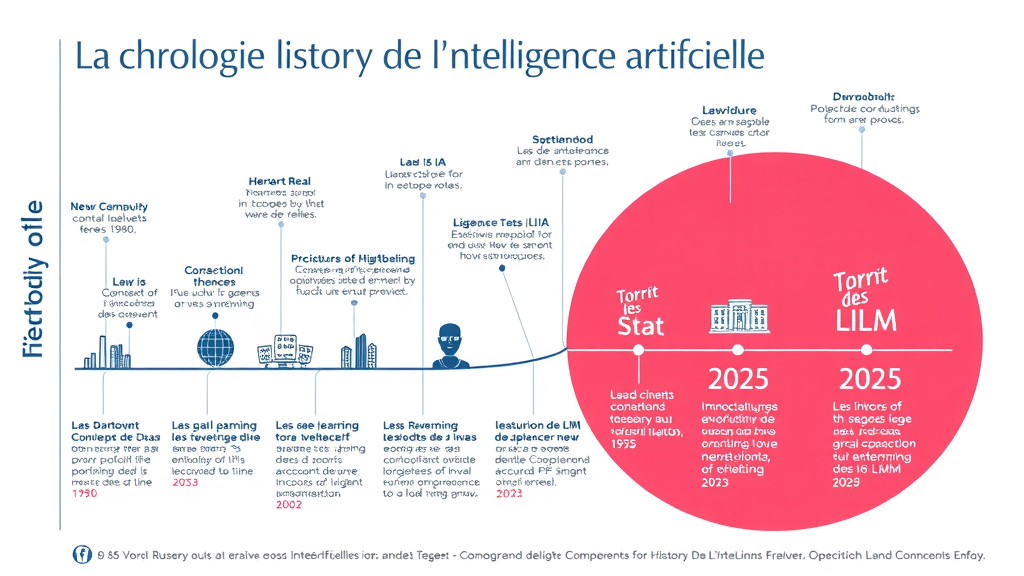
Artificial intelligence fascinates and worries in equal measure. Yet, contrary to what many think, AI was not born with ChatGPT in 2022. Its history is much richer and older, dating back several decades. Understanding this evolution is essential to grasp the current and future stakes of this technology that is transforming our daily lives. Let's dive into this fascinating timeline that leads us to the innovations of 2025.
The Theoretical Foundations: When AI Was Just a Concept
Even before the term "artificial intelligence" was officially adopted, pioneers were already laying the conceptual groundwork for what would become one of the most revolutionary fields of our time. It is in these early reflections that we find the roots of modern artificial intelligence.
The Forerunners and the Birth of the Term
As early as 1943, Warren McCulloch and Walter Pitts proposed a model of artificial neurons, paving the way for what would later become neural networks. But it was in 1956, at the Dartmouth conference, that the term "artificial intelligence" was officially adopted under the impetus of John McCarthy. This historic meeting brought together visionary researchers like Marvin Minsky, Claude Shannon, and Allen Newell, who laid the foundations of a still nascent discipline.
The 1950s-1960s saw the birth of the first programs demonstrating a form of intelligence: Allen Newell's Logic Theorist, capable of proving mathematical theorems, or ELIZA by Joseph Weizenbaum, which simulates a conversation with a psychotherapist. These achievements, though rudimentary by today's standards, were significant advances for the time.
Cycles of Enthusiasm and Disillusionment: The AI Winters
The history of artificial intelligence has not followed a linear progression. It has been marked by cycles of euphoria followed by periods of disillusionment, commonly called "AI winters." These fluctuations have profoundly influenced the development and funding of research in this field.
| Period | Phase | Key Events |
|---|---|---|
| 1956-1974 | First Golden Age | Creation of first AI systems, high optimism |
| 1974-1980 | First Winter | Funding cuts, criticisms from the Lighthill Report |
| 1980-1987 | Expert Systems Boom | Commercial development of rule-based systems |
| 1987-1993 | Second Winter | Commercial failure of expert systems, renewed decline in interest |
| 1993-2011 | Quiet Advances | Steady but underreported progress (Deep Blue, Watson) |
| 2012-present | AI Renaissance | Explosion of deep learning, generative AI, consumer applications |
The 1973 Lighthill Report particularly marked the first AI winter by severely criticizing the discipline's unfulfilled promises. James Lighthill, a British mathematician, concluded that AI had failed to achieve its ambitious goals, leading to a drastic reduction in public funding in the UK, then in the US.
The Deep Learning Revolution: The Decisive Turning Point
If AI is enjoying unprecedented success today, it is largely thanks to a technical revolution that occurred in the early 2010s: the advent of deep learning. This approach, inspired by the functioning of the human brain, has enabled spectacular advances in many fields.
From Machine Learning to Deep Learning
Machine learning has existed since the 1950s, but deep learning represents a major evolution of this approach. The fundamental difference lies in the use of artificial neural networks with multiple layers, allowing automatic extraction of increasingly abstract features from raw data.
In 2012, at the ImageNet competition, the team led by Geoffrey Hinton presented AlexNet, a deep neural network that far surpassed traditional methods in image recognition. This moment is considered the trigger of the deep learning revolution. Modern artificial intelligence software is almost all based on these fundamental advances.
Key Success Factors
Three main factors explain the explosion of deep learning:
- The availability of vast training datasets (big data)
- The exponential increase in computing power, especially thanks to GPUs
- Algorithmic advances like gradient backpropagation and improved activation functions
These elements have created a virtuous cycle of innovation that continues today. The computing power needed to train the most advanced models doubles about every 3.4 months since 2012, far surpassing Moore's law. This exponential growth has been made possible notably thanks to specialized chips like those developed by Nvidia, now at the heart of geopolitical tensions.
The Era of Large Language Models: The Democratization of AI
If 2022 marked a turning point in public perception of AI, it is thanks to the emergence of large language models (LLMs) like GPT and their accessibility to the general public via conversational interfaces. These models represent the culmination of decades of research.
From GPT-1 to GPT-4o: A Meteoric Evolution
OpenAI launched the first GPT model (Generative Pre-trained Transformer) in 2018, with limited capabilities compared to today's standards. But each iteration has brought significant improvements:
- GPT-1 (2018): 117 million parameters
- GPT-2 (2019): 1.5 billion parameters
- GPT-3 (2020): 175 billion parameters
- GPT-4 (2023): number of parameters undisclosed, but estimated at over 1 trillion
- GPT-4o (2024): advanced multimodal capabilities integrating text, image, and audio
The conversational interface ChatGPT, launched in late 2022, democratized access to these technologies for the general public, reaching 100 million users in just two months – the fastest growth ever seen for a consumer application. Uses of ChatGPT have multiplied, transforming many professional sectors.
The Race for Multimodal Models
In 2025, we are witnessing an intensification of competition around multimodal models, capable of simultaneously processing text, image, audio, and video. This evolution marks a new step in AI development, with increasingly diverse applications:
- Multimedia content creation (texts, images, videos, music)
- Advanced virtual assistants understanding visual and audio context
- Medical diagnostic systems combining different data sources
- Real-time design and prototyping tools
Companies like Google DeepMind, Anthropic with Claude 3.7 Sonnet, and of course OpenAI with GPT-4o, are in direct competition to develop the most powerful and versatile models.

Ethical and Societal Challenges: The Other Side of AI
The acceleration of AI capabilities raises fundamental questions about its societal impact. These concerns are not new, but they take on a more concrete dimension with the democratization of AI technologies.
Algorithmic Bias and Fairness
AI models are trained on historical data that often reflect the biases and inequalities of our societies. Without vigilance, these systems risk perpetuating, or even amplifying, these biases. Problematic cases have already been documented in sensitive areas like recruitment, credit granting, or criminal justice.
Research on "AI fairness" has grown considerably in recent years, proposing methods to detect and mitigate these biases. However, there is no universal solution, as the very notion of fairness can vary depending on cultural contexts and applications.
Privacy and Surveillance
The effectiveness of AI systems relies largely on access to enormous volumes of data, often personal. This reality raises important questions about privacy protection and informed consent of users.
The General Data Protection Regulation (GDPR) in Europe has established an important legal framework, but many challenges remain, particularly concerning:
- Transparency of algorithms and the right to explanation
- Ownership of data generated by interactions with AI
- Risks of mass surveillance facilitated by facial and behavioral recognition technologies
- The environmental impact of AI linked to the massive energy consumption of data centers
AI in 2025: Between Myth and Reality
In 2025, artificial intelligence continues to progress at a sustained pace, but it is important to distinguish real advances from media exaggerations. Contrary to some preconceived ideas, current AI is not a conscious intelligence comparable to that of humans.
What AI Can Do in 2025
Current AI systems excel in specific areas:
- High-quality natural language processing and generation
- Creation of images, videos, and music from text descriptions
- Large-scale data analysis and trend prediction
- Automation of repetitive tasks and decision support
- Real-time translation between many languages
Tools like PIKA AI for video creation or Apple Intelligence integrated into iOS devices demonstrate the growing integration of these technologies into our daily lives.
Current Limitations
Despite these impressive advances, AI still has significant limitations:
- Lack of true understanding of the world and common sense
- Tendency to hallucinate (generating false information presented as true)
- Difficulty reasoning causally and transferring knowledge across domains
- Excessive dependence on training data and vulnerability to biases
- Considerable energy consumption for training large models
These limitations remind us that artificial intelligence and human intelligence remain fundamentally different in their nature and functioning.
Conclusion: Toward Human-Machine Co-evolution
The history of artificial intelligence teaches us that this discipline did not appear suddenly in 2022, but results from a long process of innovation marked by advances and setbacks. Understanding this historical trajectory allows us to approach current and future developments with more perspective.
Today, rather than systematically opposing artificial intelligence and human intelligence, the trend is toward seeking complementarities. The most effective AI systems are those that combine the computational capabilities of machines with human judgment and intuition.
This collaborative approach, sometimes called "augmented intelligence," seems to be the most promising path to leverage the benefits of AI while minimizing its risks. To explore the potential of these technologies yourself, sign up for free to Roboto and discover how AI can enrich your creativity and productivity every day.

