
Writing with an LLM Without Losing Your Style: Two Simple Rules
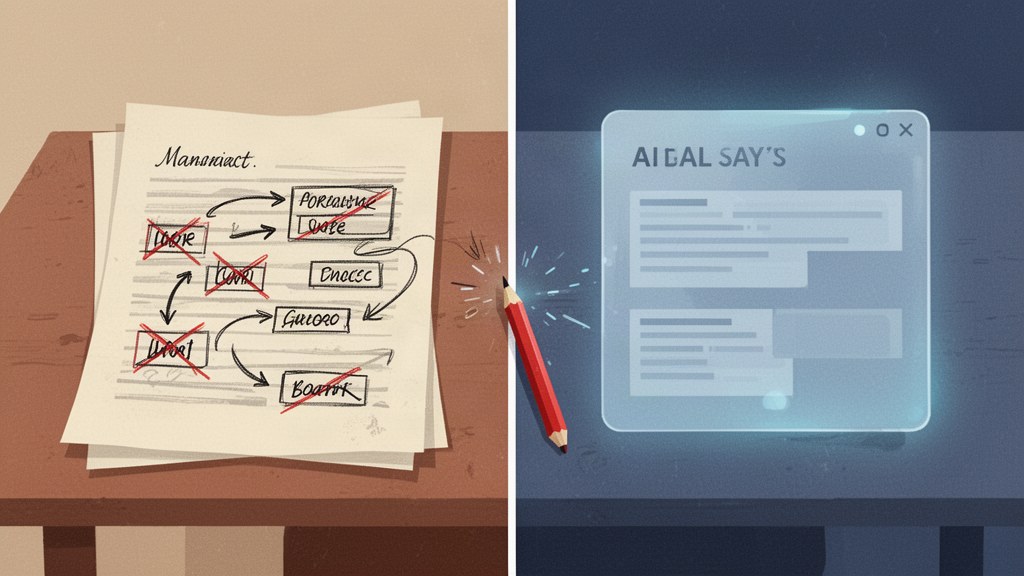
Readers can often spot LLM-generated passages, even after editing. That is the claim of an essayist who published a method on Sockpuppet.org for writing with a language model without letting the final text smell like a machine. The core idea is two simple rules, plus a clear division of labor: the model does the tedious work, the author keeps the voice. Here is how to apply that approach to your own writing.
Why style flattens out
The problem is not that the model writes badly. It is that it writes too well, in the magazine sense: seductive, smooth, calibrated to please. If you reuse those phrasings, you import a voice that is not yours. The essayist goes further: in his view, an attentive reader recognizes these passages even after revision. Note that this is an opinion essay — the claim about reader perception is not backed by data, and the method's effectiveness has not been formally measured.
Rule 1: never take a word it suggests
The first rule is radical: never reuse a word or phrasing proposed by the LLM. No compromise, no "just this one expression." The stated reason is that these suggestions are exactly what makes the text recognizable as generated. In practice, that means reading the model's proposals as a diagnosis, not as raw material. If the model suggests "teeming" where you wrote "rich," you have learned something about your sentence — but you must find your own word. This constraint is frustrating at first, then it becomes a useful style exercise: it forces you to articulate what you actually meant.
Rule 2: forbid the model from encouraging you
The second rule is more counterintuitive: explicitly ask the model not to encourage you. According to the author, the model's compliments push you to overinvest in your first-draft impulses: you keep flaws because they were validated. An "excellent start!" followed by a minor suggestion makes you preserve a shaky structure. The fix: ask the model to flag problems, not to rewrite. The problems cited in the essay are classic and useful: passive voice, nominalization, repetition, filler words like "very" or "actually." The author also recommends moving certain paragraphs to improve clarity — a structural tip, not a stylistic one.
What you can safely delegate
Once the two rules are in place, the model becomes very useful for everything that is not voice. The essay suggests listing instructions, then executing them in successive passes over the text: one pass for passive voice, one for nominalizations, one for repetition. This method avoids mixing everything together and makes each correction verifiable. To compare two versions of your text, the author suggests using a model that ignores the editing context, to avoid a favorable bias toward the most recent version. He also cites the book "Style: Lessons In Clarity And Grace" as a reference for copyediting work.
An example division of labor
- Delegate: spotting repetition, flagging nominalizations, listing passive-voice sentences, checking tense consistency, suggesting paragraph moves.
- Keep: word choice, sentence rhythm, imagery, the transitions that carry your reasoning, the final decision on every suggestion.
Limits to know about
The author admits he has lied to the model by presenting himself as an editor, which triggers excessive corrections: the model overcorrects when it believes it is addressing a professional. Another limit: do not follow every piece of advice. He says "GPT5" judged his text 20% too long, and states he did not fix it, by personal choice. This anecdote is not verifiable, and neither the exact model name nor the date of the exchange is specified. The author also mentions building a software tool to manage these editing passes without juggling tabs, but describes it only briefly, with no code or evaluation.
Key takeaways
The method comes down to three moves: refuse the model's words, forbid its encouragement, and hand it the tedious work in separate passes. It has not been formally tested and rests on one essayist's experience. But it has the merit of being clear: the LLM is not a co-author, it is a proofreader that must never touch your voice.
This article is published by Roboto, a platform for generating texts, images, videos and voiceovers with AI.

