Claude Meetings: an assistant that takes notes and builds docs during your video calls
Make a video from a simple sentence — free credits on sign-up Create my first video
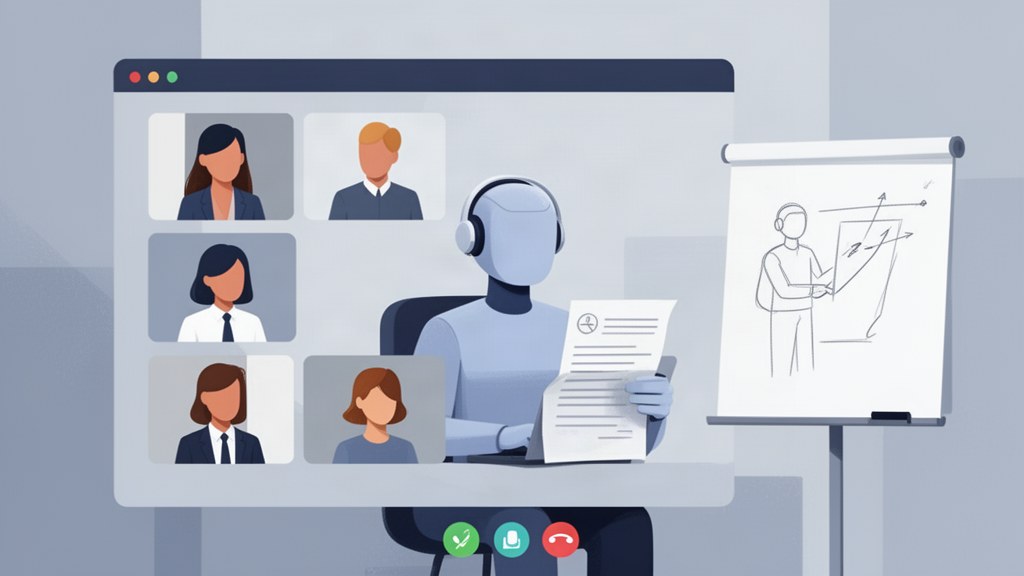
Anthropic has announced Claude Meetings, a feature that lets Claude join a video call as a visible participant, follow the conversation and produce notes, answers, documents and whiteboards while the call is happening. The announcement, published on claude.com, describes a beta rollout on Team and Enterprise plans, with Google Meet as the only supported platform for now. For a creator or a small team, the appeal is clear: hand off note-taking and idea structuring while the discussion continues. The real questions are what the tool actually does, what it does not do, and what privacy issues it raises.
What Claude does during a meeting
According to the official description, Claude joins the call as a visible participant and follows the conversation. Teams can ask it questions out loud or in writing during the meeting. By default, it answers in writing and can use connected tools it has been authorized to access. It also drafts documents and whiteboards live, which colleagues can then edit. Finally, it takes notes and captures action items, so nobody on the call has to do it.
Each meeting gets its own page in claude.ai, with notes, transcript and the content created. That is probably the most useful part day to day: instead of scattered notes, all the material from a call sits in one place.
Practical uses for a creator or small team
Preparing and running a brief
On a briefing call with a client or collaborator, Claude can act as active memory: ask it to summarize decisions, list expected deliverables or rephrase an ambiguous point. The answer appears in writing, which leaves time to read it without interrupting the conversation.
Turning a discussion into a document
Generating documents and whiteboards during the call can save time on repetitive tasks: sketching a content plan, outlining an editorial calendar, structuring a tracking table. Colleagues can edit these outputs, which makes them a starting point rather than a fixed result.
No more lost action items
Automatic note-taking and action-item capture address a classic problem: nobody wants to write the minutes, and decisions get lost. Here, the meeting page keeps notes and transcript, which makes follow-up after the call easier.
Limits and things to watch
Several restrictions are explicit in the announcement. The beta covers Google Meet only; no date is given for other platforms. Some organizations are not eligible, including those on zero retention, HIPAA configuration or using CMEK keys. By default, Claude does not join calls with external guests and leaves if an external guest arrives; an administrator can allow it on those calls.
The mechanics of the spoken-speaker confirmation are not detailed: the announcement says Claude asks each time to confirm who is speaking, without explaining exactly how. Likewise, how meeting pages are shared outside the organization is not specified, nor whether external guests can view those pages. These gaps are worth checking before heavy use.
Privacy: what is recorded and what is not
Claude records a transcript, a summary and screen descriptions, but not audio, according to the announcement. It uses each person's connected tools with their permission, requested the first time. This matters for a team handling client information: the transcript and screen descriptions are sensitive data, even without audio.
Participant consent is not covered in detail in the announcement. For a creator working with clients or freelancers, it is prudent to tell participants that an assistant is transcribing, and to check administrator settings before enabling Claude on calls involving third parties.
Pricing and availability
During the beta, notes, transcripts and answers are free on Team and Enterprise, except when connected tools are used. Documents and whiteboards created during a call are free until February 10, 2027. Beyond those dates, pricing terms are not specified in the announcement.
Partnerships with tools such as Gong, Otter or Fireflies.ai are meant to let transcripts be sent to other services. Details of these integrations are not yet known.
Key takeaways
- Claude Meetings joins calls as a visible participant and follows the conversation, in beta on Team and Enterprise.
- Google Meet is the only supported platform for now; no date is announced for others.
- Notes, action items, documents and whiteboards are produced during the call and gathered on a meeting page.
- Transcript and screen descriptions are recorded, not audio.
- Calls with external guests are excluded by default unless an administrator allows them.
- Some organizations (zero retention, HIPAA, CMEK) are not eligible for the beta.
For a creator, the tool is most interesting as a friction reducer on briefing and follow-up meetings. It does not replace a human decision about what should be shared, and the gaps around page sharing and participant consent justify a cautious trial phase.