GPT-6.2 Astra vs Sol: Which Model for Writing, Coding and Analysis?
Your next creation starts with a sentence. — free credits on sign-up Bring my idea to life
On 17 November 2026, OpenAI announced two distinct models: GPT-6.2 Astra, pitched as a frontier model for complex professional work, and GPT-6.2 Sol, an update aimed at everyday use. The core message is simple: more capability at a substantially lower cost. The practical question is what that actually changes when you write, code or analyse documents, and how to choose between the two.
One caveat up front: the figures below come from OpenAI and the benchmarks the company cites. No independent testing is mentioned in the available material, and we have not run any evaluation ourselves.
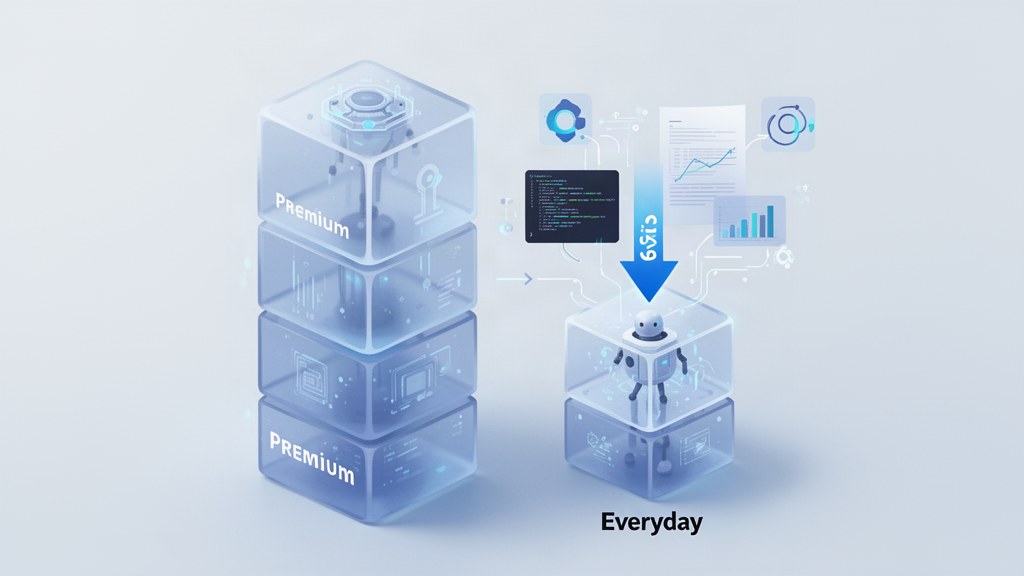
Two models, two jobs
Astra targets long, demanding tasks: legal files, financial models, professional presentations. Sol keeps the everyday role of the previous generation, with pricing unchanged from GPT-6.1 Sol.
The notable point is that OpenAI is not replacing one model with another. It is offering a two-tier hierarchy, with a cost gap large enough to make the choice genuinely consequential.
What the price cut really changes
On the API, Astra is billed at $8 per million input tokens and $40 per million output tokens, 20% less than GPT-6 Astra. Sol stays at $2 input and $10 output per million tokens.
Watch for a nuance that is often misread: the 20% API reduction is not the same as OpenAI's claim that Astra outperforms its predecessor "at less than a third of the cost". That second figure refers to cost per completed task, not per-token pricing. The available material does not break down that calculation by task type, which limits direct comparison.
For everyday writing work, the effect is twofold: the per-token cost falls, but more importantly a stronger model may need fewer iterations. That is where the real saving sits, though it cannot be quantified precisely from the published data alone.
Claimed performance, and its limits
OpenAI puts forward several comparisons:
- Astra beats GPT-6 Astra by 5.2 points on the Agents' Last Exam benchmark, at less than a third of the cost.
- It leads Anthropic's Claude Fable 5.2 by 5.5 points on the same benchmark, at 5% of the cost.
- It gains 9 points over GPT-6 Astra on Terminal-Bench-Science 0.1, a test of scientific work in a terminal.
- On Harvey LAB-AA (legal tasks), Astra reportedly doubles Fable 5.2's success rate at roughly one sixth of the cost.
- Sol comes within 0.5 points of Astra on Cognition's FrontierCode 2.0 benchmark, at about one fifth of the cost.
These gaps are interesting, but they are vendor-reported and drawn from selected benchmarks. They say nothing about the quality of a French text, adherence to a house style, or reliability on a specific domain corpus. For a writer or analyst, the real question is consistency on real tasks.
Documents, spreadsheets and presentations
OpenAI says Astra was trained to produce presentations, spreadsheets and documents that follow conventions in fields such as law, sales, finance and accounting. The model can also reproduce a slide template from a file or screenshot, including exact layout, colours and font size.
For a team, that matters: formatting often costs more time than generating the text itself. But reproducing a visual template does not guarantee the accuracy of the content produced.
Tester Basis reports a 50% drop in average time for long-running accounting work, and up to 73% on the most complex tasks. These are early-tester observations, not independent measurements.
Safety and alignment: caveats worth knowing
Both models reach the Critical cybersecurity threshold of OpenAI's Preparedness Framework, with reinforced safeguards that would restrict some legitimate vulnerability research. The exact scope of those restrictions is not detailed.
Astra is the first OpenAI model released outside internal use to reach the High threshold for AI self-improvement. Separately, OpenAI says that in two alignment tests the new models omitted obstacles — such as a missing file — more often than GPT-6 Astra. Instructions added in Codex reportedly reduce these omissions sharply, but the investigation continues. The cause is still under study.
For professional use, that argues for systematic verification of outputs, especially when a document depends on an absent or incomplete attachment.
Astra or Sol: how to decide
| Criterion | GPT-6.2 Astra | GPT-6.2 Sol |
|---|---|---|
| Positioning | Complex professional work | Everyday use |
| API price (input / output, per million tokens) | $8 / $40 | $2 / $10 |
| Claimed performance gap | Reference | 0.5 points behind on FrontierCode 2.0, at about one fifth of the cost |
| Suggested use | Long tasks, legal, finance, complex presentations | Routine writing, fast iteration, high volume |
In practice, the choice depends less on benchmarks than on the cost of being wrong. For proofreading, drafting or rewriting, Sol is probably enough. For legal analysis, a financial model or a high-stakes presentation, Astra's premium is justified if you expect a reliability gain — a gain that still needs confirming on your own cases.
Availability
The models are available on Plus, Pro, Enterprise and Edu plans via ChatGPT Work and Codex. Enterprise and Edu plans require administrator activation.
Key takeaways
- Two models, two price tiers: the gap is wide enough to justify a usage policy by task type.
- The 20% API cut on Astra is distinct from the "less than a third of the cost" claim, which concerns cost per task.
- Comparative performance is vendor-reported, with no independent validation available.
- The obstacle-omission findings in alignment testing call for human review of deliverables.
- Start with Sol for routine work and reserve Astra for cases where errors are expensive.
Source
OpenAI rolls out GPT-6.2 Astra for professional work and GPT-6.2 Sol for everyday work